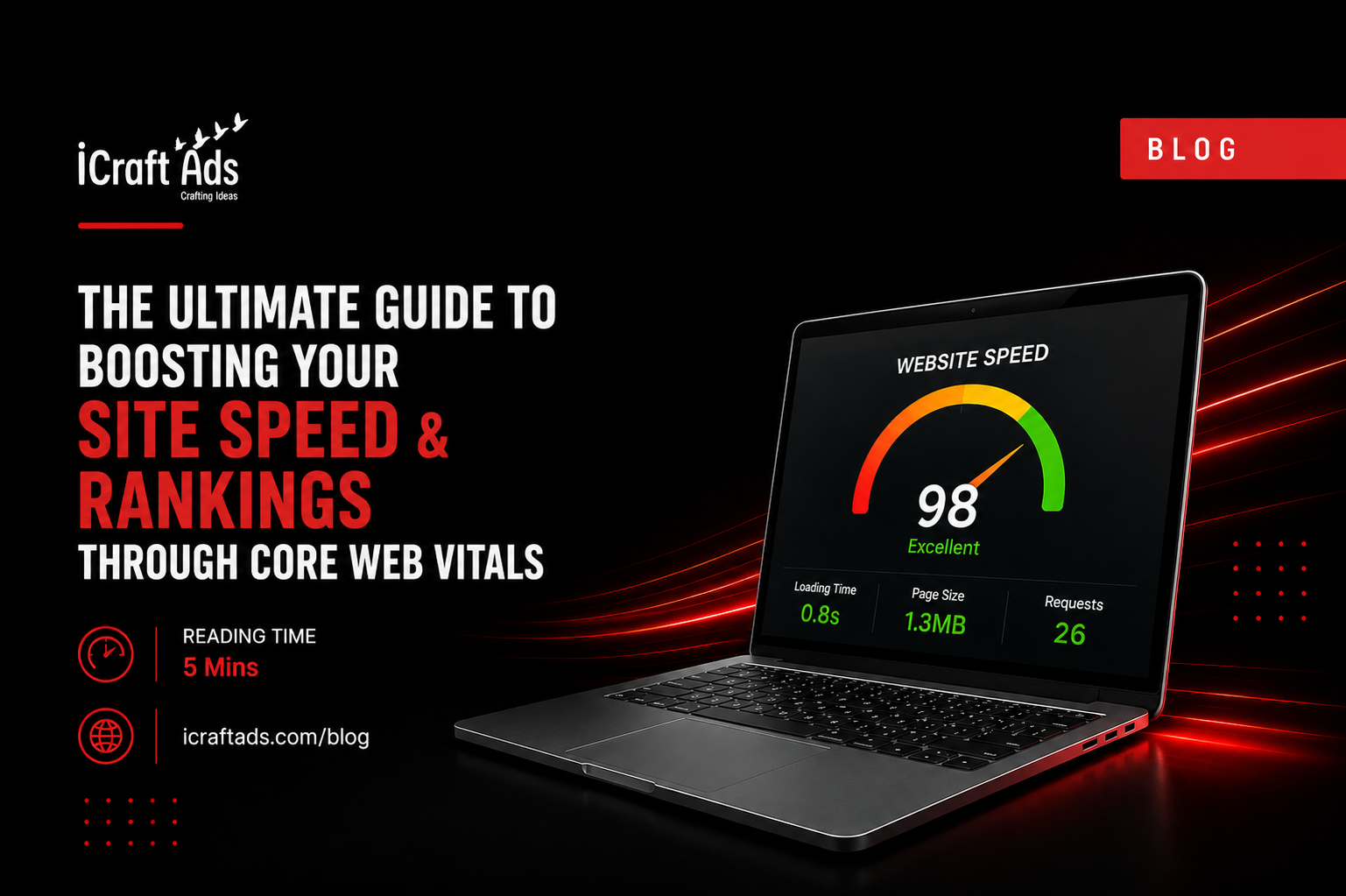
If your website feels slow, or your rankings have been stuck despite good content, the problem might not be your SEO strategy at all. Maybe it’s even your Core Web Vitals. In 2026, Google still uses these metrics as part of their ranking criteria, meaning that knowing how to improve page speed and optimizing your site can’t be ignored.
We’ll take you through all you need to know about Core Web Vitals, how important INP optimization has become, and all about page speed optimization so that your website gets ranked and satisfies your visitors.
What Are Core Web Vitals?
Core Web Vitals are a suite of performance metrics that Google uses to understand the quality of users’ experiences on your website. They revolve around the aspects of loading time, interaction, and visual stability of the website.
LCP, INP, and CLS Explained
There are three Core Web Vitals that can be defined in 2026:
- LCP (Largest Contentful Paint) calculates the amount of time it takes to load the main contents of your webpage.
- INP (Interaction to Next Paint) calculates the speed at which your website responds to any click, tap or keystroke of the user.
- CLS (Cumulative Layout Shift) calculates the shifting of the layout of your webpage while it loads.
Together, these three metrics tell Google, and your visitors, how good your website really feels to use.
Why Page Speed Optimize Matters for Rankings
Google has made it clear that user experience plays a direct role in search rankings. Optimizing your site is about more than just pleasing Google; it’s about increasing conversions, decreasing bounce rates, and engaging visitors for longer periods of time.
Here are a few reasons why a slower website might negatively impact your busines
- Higher bounce rates because visitors leave before the page is loaded
- Decreased conversion rates on both product and service pages
- Reduced visibility in search results
- Mobile performance issues, since that makes up the majority of your visitors
Essentially, if you are going to succeed with SEO in 2026, page speed optimization needs to be one of your top priorities.
INP Optimization: The Metric That Replaced FID
The most important change in the Core Web Vitals recently is the replacement of FID (First Input Delay) with INP. This implies that INP optimization is imperative for anyone who is serious about site performance.
Causes of Poor INP Performance Scores
Some causes of poor INP performance include:
- A heavy use of JavaScript causing browser blockage
- Multiple third-party scripts (ads, tracking codes, chat applications)
- Large unoptimized websites with a lot going on
- Server response delay during users’ interaction
How to Improve INP
To make INP optimization better, there is no need for a full-scale redesign. It is quite enough to make small adjustments here and there:
- Split long JavaScript functions into smaller ones
- Omit or defer unneeded third-party scripts
- Implement browser caching to avoid extra computations
- Process the code for user visible/interacting parts first
Even slight INP improvement can yield noticeable benefits for your website visitors.
Page Speed Optimization Step-by-Step Checklist
When you are prepared to optimize your web page, the following list can be quite handy.
Optimizing Images and Media
The image size is one of the most common issues that slow down your website. You need to compress images and use modern image formats such as WebP.
Optimizing Code and Scripts
Well-written, concise code will load faster. Make sure to minify your CSS and JS code and get rid of unnecessary code and scripts on the website.
Hosting and Server Response
Hosting is more important than you may think. A fast, reliable server reduces load times before your page even starts rendering. Consider a content delivery network (CDN) to serve your site faster to visitors around the world.
Tools to Measure Core Web Vitals
You don’t have to guess how your site is performing. These tools will come in handy:
- PageSpeed Insights from Google for an instant performance overview
- Search Console from Google for tracking actual Core Web Vitals statistics
- Lighthouse from Google for comprehensive technical audit
- DevTools from Chrome for debugging
Checking these tools regularly will help you identify problems before they impact your rankings.
Common Mistakes That Harm Site Speed
There is always the tendency for even the best of intentions to cause these errors:
- Using too many plugins without checking what they do to your page loading time
- Focusing more on desktop rather than mobile optimization
- Overlooking auditing of sites after any kind of changes have been made
- Thinking that optimizing page speed is a one-off job
Avoiding these mistakes keeps your site fast and your rankings stable over time.
How ICraftAds Can Help You Boost Speed and Rankings of Your Website
Improvement of Core Web Vitals can be considered complicated and time-consuming, particularly if you have to handle some other things. Here is where iCraftAds will step in.
At ICraftAds, we provide businesses with comprehensive optimization of their websites through an integrated technical process that includes everything from optimization of images and codes to addressing INP optimization problems. Our team not only increases the speed but also applies mobile-first concepts to maximize the conversion rate.
Are you tired of losing your rankings and visitors because of the poor speed of your website? Then, ICraftAds can help you create a fast and optimized site.
Conclusion
The Core Web Vitals will not be a thing of the past in 2026 and continue to impact the ranking and performance of your website. Focusing on page speed optimization techniques and INP optimization will enable you to build a website that is fast, responsive, and retains visitors. Little by little makes much in a short while, and using the right strategy or partner like ICraftAds, you can make your website fast and future proofed.
Frequently Asked Questions
What is a good INP score?
An INP score below 200 milliseconds is a good score, as per the Core Web Vitals guidelines by Google.
How frequently should I optimize my website?
It is advisable to optimize your website every three months or after redesigns and upgrades to your website.
Does site speed have an effect on SEO?
Yes, the Core Web Vitals such as INP is one of Google’s ranking signals, and therefore speed and user experience have a direct impact on your rankings.
Is it possible to optimize Core Web Vitals without developers?
Some of the things that you can do without being a developer include image compression and eliminating unnecessary plugins.